

New Paper published in FEBS openbio
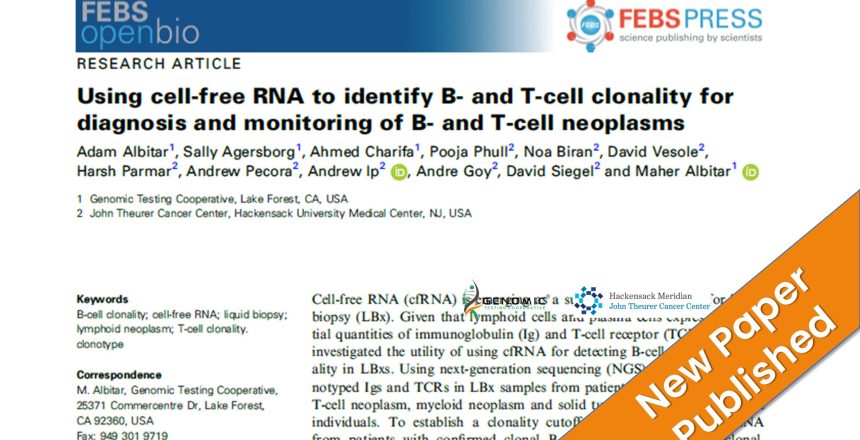
Cell-free RNA (cfRNA) is emerging as a supplemental approach for liquid biopsy (LBx). Given that lymphoid cells and plasma cells express substantial quantities of immunoglobulin (Ig) and T-cell receptor (TCR) RNA, we investigated the utility of using cfRNA for detecting B-cell and T-cell clonality in LBxs.
Using next-generation sequencing (NGS) of cfRNA, we clonotyped Igs and TCRs in LBx samples from patients with B-cell neoplasm, T-cell neoplasm, myeloid neoplasm and solid tumors alongside cancer-free individuals. To establish a clonality cutoff, we clonotyped tissue RNA from patients with confirmed clonal B- or T-cell and from polyclonal.
Clonotype-na€ıve testing of LBx samples demonstrated B-cell clonality in myeloid neoplasms, and 14% of solid tumors. T-cell clonality using TCR beta or gamma demonstrated T-cell clonality in 22% of T-cell neoplasms,
3% of normal, 5% of myeloid neoplasms, 7% of solid tumors and 3% of B-cell neoplasms. This confirms that Clonotype-na€ıve cfRNA testing in LBx is a reliable approach for detecting B- and T-cell clonality.
Short Summary
A newly published study by Dr. Maher Albitar and collaborators from Genomic Testing Cooperative and John Theurer Cancer Center explores the use of cell-free RNA (cfRNA) for detecting B-cell and T-cell clonality through liquid biopsy.
Using next-generation sequencing, the researchers demonstrated that cfRNA-based testing can reliably identify B- and T-cell clonality without requiring prior knowledge of a specific clonotype. The findings support the potential use of cfRNA as a supplemental, minimally invasive approach for the diagnosis and monitoring of lymphoid neoplasms.
Published in: FEBS Open Bio
DOI: 10.1002/2211-5463.70323